Charles Carter

University of Phoenix
Teacher/Tutor

Biography

I tutor middle and high school math students from 7th grade math through Joint Enrolled in Calculus 2 (Linear Algebra included). I can work with all Math topics through Analysis classes at UGA. I also worked with Princeton Review for several years working with SAT and GRE students. I can teach/tutor Physics as well through beginning Mechanical Engineering courses.

Education

MA Secondary Education
University of Phoenix
BS Mathematics
Kennesaw State University

Educator Statistics

Numerade tutor for 7 years
4765 Students Helped

Topics Covered

Mastering Integration Techniques for Optimal Results
Improper Integrals
Mastering Matrices: An Introduction to the Fundamentals
Mastering Multiple Integrals: Techniques and Tips
Mastering Quadratic Functions: Unlocking Their Power
Understanding Complex Numbers: A Comprehensive Guide
Mastering Polynomials: Essential Tips and Tricks | [Brand Name]
Rational Functions: Understanding Their Properties and Applications
Mastering Equations and Inequalities: Your Guide to Mathematical Success
Solving Systems of Equations and Inequalities: A Comprehensive Guide
Unlocking the Power of Functions: Boost Your Programming Skills
Discover the Power of Polygons: Unleash Your Creativity with Our Comprehensive Guide
Transform Your Life with Powerful Transformations Techniques
Discover the Power of Similarity - Boost Your Results Today!
Discover the Relationship Between Parallel and Perpendicular Lines
Mastering Exponents and Polynomials: A Comprehensive Guide
Functions
Mastering Exponential and Logarithmic Functions: Your Ultimate Guide
The Power of Algebraic Language: Unlocking Mathematical Potential
Discover the Power of Ratio Proportions and Measurements
Master Trigonometry with Our Comprehensive Guide
Maximizing Accuracy with Effective Sampling and Data Analysis
Understanding the Normal Distribution: A Comprehensive Guide
Introduction to Combinatorics & Probability: Understanding the Basics
Discover the Wonders of Geometry: An Introduction to Shapes and Space
Discover the Basics of Trigonometry: Your Introduction to Triangles
Discover the Properties of Quadrilaterals: A Comprehensive Guide
Unlock the Power of Sequences: Boost Your Productivity
Discover the Best Series to Binge-Watch | Your Ultimate Guide
Master Algebra Basics: Topics Reviewed at Semester Start
Introduction to Sequences and Series
Mastering Matrices: Essential Tips and Tricks | Boost Your Math Skills
Introduction to Conic Sections
Discovering Conic Sections: An Introduction
Mastering Linear Functions: A Comprehensive Guide
Discover the Power of Right Triangles in Geometry
Circles: Exploring the Beauty and Significance of Circular Shapes
Polar Coordinates: Understanding the Basics and Applications
Unlock Insights with Data-Driven Graphs & Statistics
Introduction to Combinatorics and Probability
Mastering Fractions and Mixed Numbers: A Comprehensive Guide
Discovering the Fundamentals: Newton's Laws of Motion Explained
Exploring the Functions of Multiple Variables
Mastering Integrals: Tips and Tricks for Calculus Success
Integration
Vector Functions: Understanding the Basics
Mastering Partial Derivatives: Essential Techniques and Tips
Master Vector Calculus with Our Comprehensive Guide
Breaking Limits: Unlock Your Potential with Our Expert Solutions
Explore the Power of Continuous Functions: Boost Your Mathematical Skills
Mastering Vectors: An Introduction to Vector Basics
Discover the Properties of Congruent Triangles | Exploring Geometry
Exploring Relationships Within Triangles
Maximize Your Results with Surface Area Optimization
Boost Your Business with High Volume Solutions
Unlocking the Power of Probability: A Guide to Making Informed Decisions
Mastering the Basics of Parametric Equations: A Comprehensive Guide
Unlock the Power of Vectors: Discover Their Limitless Possibilities
Exploring Probability Topics: From Basics to Advanced Strategies
Unlocking the Power of Confidence Intervals: A Comprehensive Guide
Hypothesis Testing with Two Samples: A Comprehensive Guide
Unlocking Insights with Descriptive Statistics: A Comprehensive Guide
The Central Limit Theorem: Understanding Statistical Sampling
Hypothesis Testing with One Sample: A Comprehensive Guide
Applications of Integration: Exploring Real-World Solutions
Foundations for Geometry: Building Blocks for Mathematical Understanding
Master Geometry Basics for a Strong Foundation
Differential Equations Made Simple: Expert Tips & Resources
Exploring the World of Derivatives: A Comprehensive Guide
Stand Out with Differentiation Strategies | Boost Your Business
Applications of the Derivative
Mastering Second Order Differential Equations: Tips and Techniques
Write Linear Equations
Linear Equations and Functions
Understanding Electromagnetic Waves: A Comprehensive Guide
Understanding Reflection and Refraction of Light: A Comprehensive Guide
Explore the Fascinating World of Wave Optics - Unleash Its Potential
The Power of Integers: Unlocking Their Potential
Master Algebra and Trigonometry with Our Expert Courses
Understanding Temperature and Heat: A Comprehensive Guide
Unlocking the Secrets of Thermal Properties: Understanding Matter
Understanding the First Law of Thermodynamics: Key Concepts
Understanding the Second Law of Thermodynamics: Key Principles
Unlocking the Power of Geometric Proof: A Comprehensive Guide
Unlock the Power of Logic: Boost Your Critical Thinking Skills
Calculate Area and Perimeter - Easy Online Tools

Charles's Textbook Answer Videos

13:52
Calculus: Early Transcendentals

In Example 5, we modeled a measles pathogenesis curve by a function $ f $. A patient infected with the measles virus who has some immunity to the virus has a pathogenesis curve that can be modeled by, for instance, $ g(t) = 0.9 f(t) $.
(a) If the same threshold concentration of the virus is required for infectiousness to begin as in Example 5, on what day does this occur?
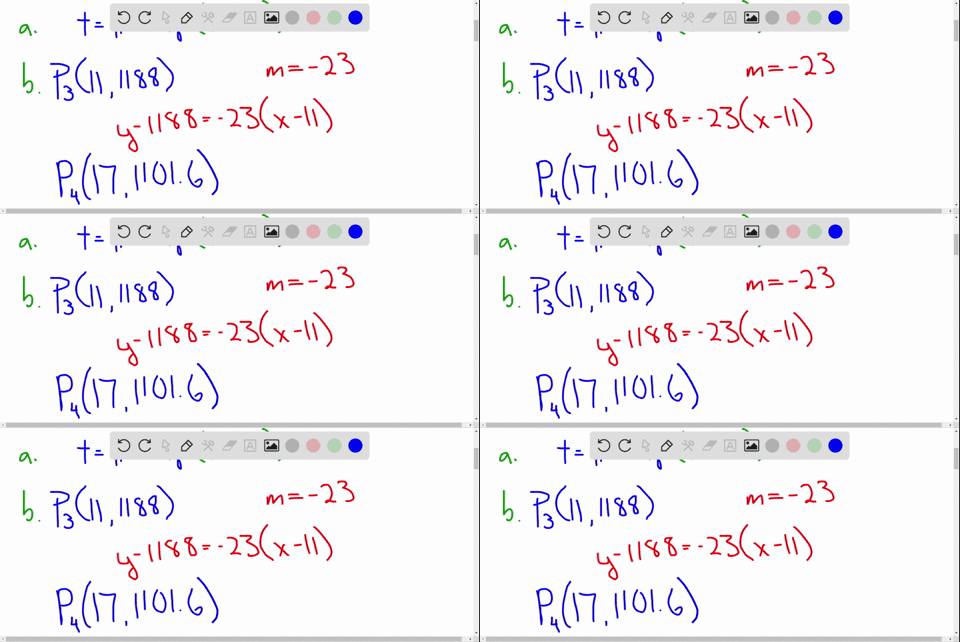
(b) Let $ P_3 $ be the point of the graph of $ g $ where infectiousness begin. It has been shown that infectiousness ends at a point $ P_4 $ on the graph of $ g $ where the line through $ P_3 $, $ P_4 $ has the same slope as the line through $ P_1 $, $ P_2 $ in Example 5(b). On what day does infectiousness end?
(c) Compute the level of infectiousness for this patient.

Chapter 6: Applications of Integration
Section 1: Areas Between Curves
Charles Carter
02:10
Calculus: Early Transcendentals

Two cars, A and B, start side by side and accelerate from rest. The figure shows the graphs of their velocity functions.
(a) Which car is ahead after one minute? Explain.
(b) What is the meaning of the area of the shaded region?
(c) Which car is ahead after two minutes? Explain.
(d) Estimate the time at which the cars are again side by side.

Chapter 6: Applications of Integration
Section 1: Areas Between Curves
Charles Carter
10:15
Calculus: Early Transcendentals

A model for tumor growth is given by the Gompertz equation
$ \frac {dV}{dt} = a (\ln b - \ln V) V $
where $ a $ and $ b $ are positive constant and $ V $ is the volume of the tumor measured in $ mm^3. $
(a) Find a family of solution for tumor volume as a function of time.
(b) Find the solution that has an initial tumor volume of $ V(0) = 1 mm^3. $

Chapter 9: Differential Equations
Section 3: Separable Equations
Charles Carter
10:38
Calculus: Early Transcendentals

In Section 9.3 we looked at mixing problems in which the volume of fluid remained constant and saw that such problems give rise to separable differentiable equations. (See Example 6 in that section.) If the rates of flow into and out of the system are different, then the volume is not constant and the resulting differential equation is linear but not separable.
A tank contains 100 L of water. A solution with a salt concentration of 0.4 kg/L is added at a rate of 5 L/min. The solution is kept mixed and is drained from the tank at a rate of 3 L/min. If $ y(t) $ is the amount of salt (in kilograms) after $ t $ minutes, show that $ y $ satisfies the differential equation
$ \frac {dy}{dt} = 2 - \frac {3y}{100 + 2t} $
Solve this equation and find the concentration after 20 minutes.

Chapter 9: Differential Equations
Section 5: Linear Equations
Charles Carter
08:34
Precalculus with Limits

A roofing contractor is fabricating gutters from 12-inch aluminum sheeting. The contractor plans to use an aluminum siding folding press to create the gutter by creasing equal lengths for the sidewalls (see figure).

(a) Let $ x $ represent the height of the sidewall of the gutter. Write a function $ A $ that represents the cross-sectional area of the gutter.
(b) The length of the aluminum sheeting is 16 feet.Write a function $ V $ that represents the volume of one run of gutter in terms of $ x $.
(c) Determine the domain of the function in part (b).
(d) Use a graphing utility to create a table that shows sidewall heights $ x $ and the corresponding volumes $ V $.Use the table to estimate the dimensions that will produce a maximum volume.
(e) Use a graphing utility to graph $ V $. Use the graph to estimate the value of $ x $ for which $ V(x) $ is a maximum. Compare your result with that of part (d).
(f) Would the value of $ x $ change if the aluminum sheeting were of different lengths? Explain.

Chapter 2: Polynomial and Rational Functions
Section 2: Polynomial Functions of Higher Degree
Charles Carter
05:22
Precalculus with Limits

In Exercises 7 - 10, determine whether each ordered pair is a solution of the system of equations

$ \left\{\begin{array}{l} 2x - y = 4\\8x + y = -9\end{array}\right. $

(a) $ (0 , -4) $
(b) $ (-2 , 7) $
(c) $ (\dfrac{3}{2} , -1) $
(d) $ (- \dfrac{1}{2} , -5) $

Chapter 7: Systems of Equations and Inequalities
Section 1: Linear and Nonlinear Systems of Equations
Charles Carter
1 2 3 4 5 ... 793