Donald Albin

Lehigh University
Math Intervention Teacher

Biography

I am an experienced Math Intervention Teacher at a middle school for advanced students. I formerly taught at the high school, college, and elementary levels, as well as enjoyed a 13-year career as a Mechanical Engineer.

(I can teach any math, including Linear Algebra and Calculus. I can also teach physics.)

Education

MS Mechanical Engineering
Lehigh University
MS Curriculum & Instruction
Shippensburg University of Pennsylvania
BS Engineering Science
Pennsylvania State University

Educator Statistics

Numerade tutor for 6 years
3711 Students Helped

Topics Covered

Maximizing Accuracy with Effective Sampling and Data Analysis
Exploring Probability Topics: From Basics to Advanced Strategies
Master Probability and Counting Rules for Better Outcomes
Mastering the Basics of Parametric Equations: A Comprehensive Guide
Polar Coordinates: Understanding the Basics and Applications
Master Trigonometry with Our Comprehensive Guide
Mastering Vectors: An Introduction to Vector Basics
Understanding Complex Numbers: A Comprehensive Guide
Mastering Matrices: Essential Tips and Tricks | Boost Your Math Skills
Rational Functions: Understanding Their Properties and Applications
Solving Systems of Equations and Inequalities: A Comprehensive Guide
Mastering Matrices: An Introduction to the Fundamentals
Functions
Mastering Linear Functions: A Comprehensive Guide
Mastering Polynomials: Essential Tips and Tricks | [Brand Name]
Find Your Dream Job: Discover the Best Work Opportunities
Unlock the Power of Kinetic Energy: Boost Your Efficiency Today
Unlocking the Power of Potential Energy: Discover the Benefits
Save Energy and Money with Effective Conservation Techniques
Understanding Moment Impulse and Collisions for Better Physics
Mastering Newton's Laws: Tips for Applying Them Effectively
Mastering the Rotation of Rigid Bodies: Tips & Techniques
Explore the Fascinating Dynamics of Rotational Motion
Understanding Equilibrium and Elasticity: A Comprehensive Guide
Discover the Power of Gravitation: Exploring the Science Behind It
Unlock the Power of Vectors: Discover Their Limitless Possibilities
Unlocking the Secrets of Thermal Properties: Understanding Matter
Understanding the First Law of Thermodynamics: Key Concepts
Understanding the Second Law of Thermodynamics: Key Principles
Understanding Electromagnetic Waves: A Comprehensive Guide
Explore the Fascinating World of Wave Optics - Unleash Its Potential
Unlocking the Power of Magnetic Fields and Forces
Exploring the Fascinating World of Mechanical Waves
Understanding Reflection and Refraction of Light: A Comprehensive Guide
Understanding Temperature and Heat: A Comprehensive Guide
Calculating Electrical Power: Resistance and EMF
Master Direct Current Circuits with Our Expert Guide
Electromagnetic Induction: Understanding the Science and Applications
Understanding Alternating Current: A Comprehensive Guide
Gravity, Planetary Orbits
Sampling and Simulation Techniques for Accurate Data Analysis
Linear Regression & Correlation: Analyzing Data Relationships
Master the Fundamentals of Physics: Learn Physics Basics
Mastering Motion: Achieving Efficiency Along a Straight Line
Motion in 2d or 3d
Discovering the Sources of Magnetic Fields: A Comprehensive Guide
Understanding Inductance: A Comprehensive Guide
Stand Out with Differentiation Strategies | Boost Your Business
Exploring the World of Derivatives: A Comprehensive Guide
Applications of the Derivative
Applications of Integration: Exploring Real-World Solutions
Discovering the Fundamentals: Newton's Laws of Motion Explained
Introduction and Vectors
Motion
Exploring the Wonders of Atomic Physics: A Comprehensive Guide
Understanding Electric Charge and Field: A Comprehensive Guide
Unlock the Secrets of Fluid Mechanics with Our Expert Guide
Explore the Fascinating World of Periodic Motion - Learn More Today!
Discover the Science of Sound and Hearing: Your Guide to Better Listening
Applications of Newton’s Laws
Rotational Motion
Mastering Equations and Inequalities: Your Guide to Mathematical Success
Volume
Unlocking Insights with Descriptive Statistics: A Comprehensive Guide
Unlocking Insights with Data Description: The Key to Effective Analysis

Donald's Textbook Answer Videos

08:25
Calculus: Early Transcendentals

Light enters the eye through the pupil and strikes the retina, where photoreceptor cells sense light and color. W. Stanley Stiles and B. H. Crawford studied the phenomenon in which measured brightness decreases as light enters farther from the center of the pupil. (see the figure.)

They detailed their findings of this phenomenon, known as the Stiles-Crawford effect of the first kind, in an important paper published in 1933. In particular, they observed that the amount of luminance sensed was not proportional to the area of the pupil as they expected. The percentage $ P $ of the total luminance entering a pupil of radius $ r mm $ that is sensed at the retina can be described by
$$ P = \frac{1 - 10^{-pr^2}}{pr^2 \ln 10} $$
where $ p $ is an experimentally determined constant, typically about $ 0.05 $.
(a) What is the percentage of luminance sensed by a pupil of radius $ 3 mm $? Use $ p = 0.05 $.
(b) Compute the percentage of luminance sensed by a pupil of radius $ 2 mm $. Does it make sense that it is larger than the answer to part $ (a) $?
(c) Compute $ \displaystyle \lim_{r\to 0^+} P $. Is the result what you would expect? Is this physically possible?

Source: Adapted from W. Stiles and B. Crawford, "The Luminous Efficiency of Ray Entering the Eye Pupil at Different Points." Proceedings of the Royal Society of London, Series B: Biological Sciences 112(1933): 428-50.

Chapter 4: Applications of Differentiation
Section 4: Indeterminate Forms and l'Hospital's Rule
Donald Albin
19:58
University Physics with Modern Physics

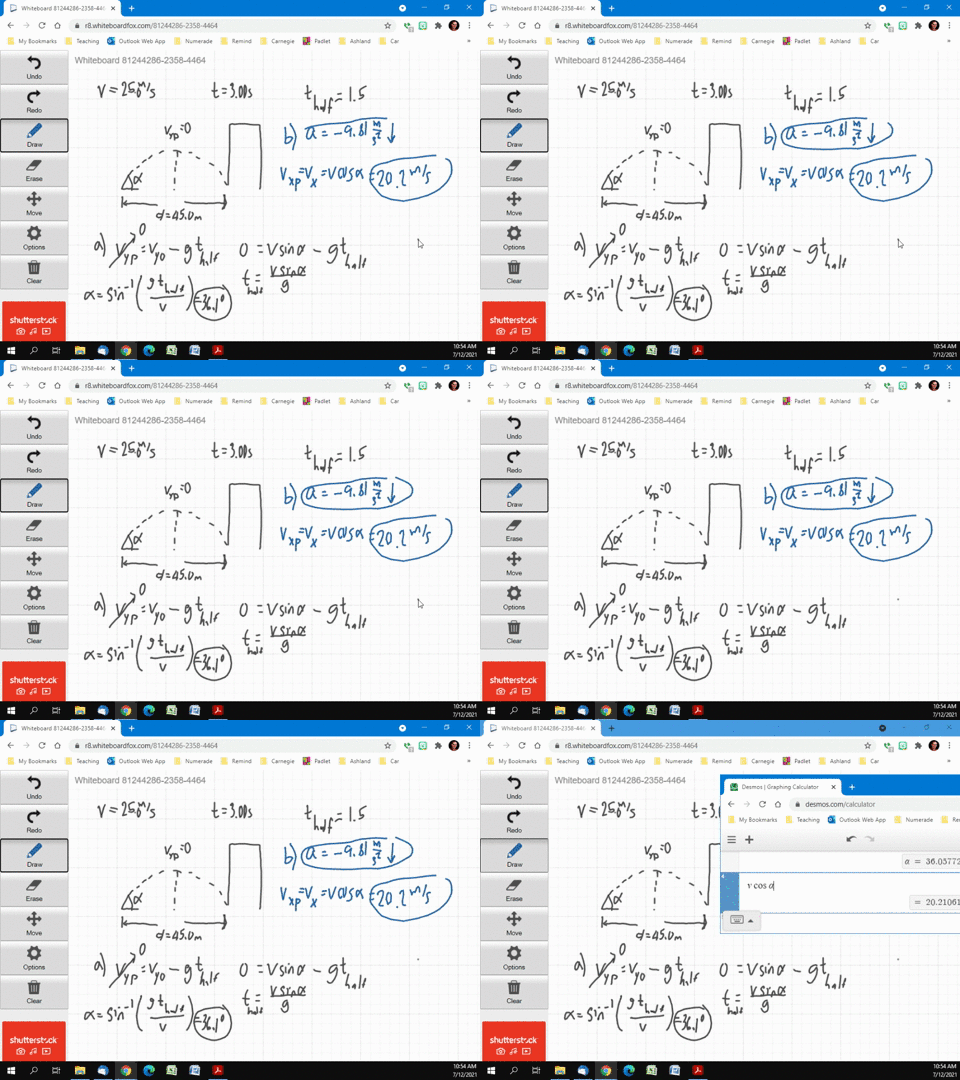
Firemen use a high-pressure hose to shoot a stream of water at a burning building. The water has a speed of 25.0 m/s as it leaves the end of the hose and then exhibits projectile motion. The firemen adjust the angle of elevation $\alpha$ of the hose until the water takes 3.00 s to reach a building 45.0 m away. Ignore air resistance; assume that the end of the hose is at ground level. (a) Find $\alpha$. (b) Find the speed and acceleration of the water at the highest point in its trajectory. (c) How high above the ground does the water strike the building, and how fast is it moving just before it hits the building?

Chapter 3: Motion in Two or Three Dimensions
Section 3: Projectile Motion
Donald Albin
08:13
University Physics with Modern Physics

At its Ames Research Center, NASA uses its large "20-G" centrifuge to test the effects of very large accelerations ("hypergravity") on test pilots and astronauts. In this device, an arm 8.84 m long rotates about one end in a horizontal plane, and an astronaut is strapped in at the other end. Suppose that he is aligned along the centrifuge's arm with his head at the outermost end. The maximum sustained acceleration to which humans are subjected in this device is typically 12.5$g$. (a) How fast must the astronaut's head be moving to experience this maximum acceleration? (b) What is the $difference$ between the acceleration of his head and feet if the astronaut is 2.00 m tall? (c) How fast in rpm (rev/min) is the arm turning to produce the maximum sustained acceleration?

Chapter 3: Motion in Two or Three Dimensions
Section 4: Motion in a Circle
Donald Albin
05:25
University Physics with Modern Physics

Two piers, $A$ and $B$, are located on a river; $B$ is 1500 m downstream from A ($\textbf{Fig. E3.32}$). Two friends must make round trips from pier $A$ to pier $B$ and return. One rows a boat at a constant speed of 4.00 km/h relative to the water; the other walks on the shore at a constant speed of 4.00 km/h. The velocity of the river is 2.80 km/h in the direction from $A$ to $B$. How much time does it take each person to make the round trip?
(Figure can't copy)Fig. E3.32

Chapter 3: Motion in Two or Three Dimensions
Section 5: Relative Velocity
Donald Albin
06:57
University Physics with Modern Physics

Two blocks connected by a light horizontal rope sit at rest on a horizontal, frictionless surface. Block $A$ has mass 15.0 kg, and block $B$ has mass $m$. A constant horizontal force $F$ = 60.0 N is applied to block $A$ ($\textbf{Fig. P4.40}$). In the first 5.00 s after the force is applied, block $A$ moves 18.0 m to the right. (a) While the blocks are moving, what is the tension $T$ in the rope that connects the two blocks? (b) What is the mass of block $B$? Figure e4.40(Figure Cant copy)

Chapter 4: Newton's Laws of Motion
Donald Albin
09:17
University Physics with Modern Physics

In a truck-loading station at a post office, a small 0.200-kg package is released from rest at point A on a track that is onequarter of a circle with radius 1.60 m ($\textbf{Fig. P7.57}$). The size of the package is much less than 1.60 m, so the package can be treated as a particle. It slides down the track and reaches point $B$ with a speed of 4.80 m/s. From point $B$, it slides on a level surface a distance of 3.00 m to point $C$, where it comes to rest. (a) What is the coefficient of kinetic friction on the horizontal surface? (b) How much work is done on the package by friction as it slides down the circular arc from $A$ to $B$?
Figure P7.57 (Figure can't copy)

Chapter 7: Potential Energy and Energy Conservation
Donald Albin
1 2 3 4 5 ... 571

Donald's Quick Ask Videos

08:25
Calculus 1 / AB

Light enters the eye through the pupil and strikes the retina, where photoreceptor cells sense light and color. W. Stanley Stiles and B. H. Crawford studied the phenomenon in which measured brightness decreases as light enters farther from the center of the pupil. (see the figure.)

They detailed their findings of this phenomenon, known as the Stiles-Crawford effect of the first kind, in an important paper published in 1933. In particular, they observed that the amount of luminance sensed was not proportional to the area of the pupil as they expected. The percentage $ P $ of the total luminance entering a pupil of radius $ r mm $ that is sensed at the retina can be described by
$$ P = \frac{1 - 10^{-pr^2}}{pr^2 \ln 10} $$
where $ p $ is an experimentally determined constant, typically about $ 0.05 $.
(a) What is the percentage of luminance sensed by a pupil of radius $ 3 mm $? Use $ p = 0.05 $.
(b) Compute the percentage of luminance sensed by a pupil of radius $ 2 mm $. Does it make sense that it is larger than the answer to part $ (a) $?
(c) Compute $ \displaystyle \lim_{r\to 0^+} P $. Is the result what you would expect? Is this physically possible?

Source: Adapted from W. Stiles and B. Crawford, "The Luminous Efficiency of Ray Entering the Eye Pupil at Different Points." Proceedings of the Royal Society of London, Series B: Biological Sciences 112(1933): 428-50.

Donald Albin
08:54
Physics 101 Mechanics

Firemen are shooting a stream of water at a burning building using a high-pressure hose that shoots out the water with a speed of 25.0 $\mathrm{m} / \mathrm{s}$ as it leaves the end of the hose. Once it leaves the hose, the water moves in projectile motion. The firemen adjust the angle of elevation $\alpha$ of the hose until the water takes 3.00 s to reach a building 45.0 m away. You can ignore air resistance; assume that the end of the hose is at ground level. (a) Find the angle of elevation $\alpha$ . (b) Find the speed and acceleration of the water at the highest point in its trajectory. (c) How high above the ground does the water strike the building, and how fast is it moving just before it hits the building?

Donald Albin
24:10
Physics 101 Mechanics

A basketball star covers 2.80 m horizontally in a jump to dunk the ball (Fig. P4.24). His motion through space can be modeled precisely as that of a particle at his center of mass, which we will define in Chapter 9. His center of mass is at elevation 1.02 m when he leaves the floor. It reaches a maximum height of 1.85 m above the floor, and is at elevation 0.900 m when he touches down again. Determine (a) his time of flight (his "hang time"), (b) his horizontal and (c) vertical velocity components at the instant of takeoff, and (d) his take-off angle. (e) For comparison, determine the hang time of a whitetail deer making a jump with center-of-mass elevations $y_{i}=1.20 \mathrm{m}, y_{\max }=2.50 \mathrm{m}, y_{f}=0.700 \mathrm{m} .$

Donald Albin
08:35
Intro Stats / AP Statistics

Team batting averages for major league baseball in 2015 are represented below. Find the variance and standard deviation for each league. Compare the results.
$\begin{array}{lcccc}{} & {\mathrm{NL}} & {} & {\mathbf{A} \mathbf{L}} & {} & {} \\ \hline 0.242-0.246 & {3} & {0.244-0.249} & {3} \\ {0.247-0.251} & {6} & {0.250-0.255} & {6} \\ {0.252-0.256} & {1} & {0.256-0.261} & {2} \\ {0.257-0.261} & {11} & {0.262-0.267} & {1} \\ {0.262-0.266} & {11} & {0.268-0.273} & {3} \\ {0.267-0.271} & {1} & {0.274-0.279} & {0}\end{array}$

Donald Albin
17:31
Physics 101 Mechanics

Figure $9-55$ shows a two-ended "rocket" that is initially stationary on a frictionless floor, with its center at the origin of an $x$ axis. The rocket consists of a central block $C$ (of mass $M=6.00 \mathrm{~kg}$ ) and blocks $L$ and $R$ (each of mass $m=2.00 \mathrm{~kg}$ ) on the left and right sides. Small explosions can shoot either of the side blocks away from block $C$ and along the $x$ axis. Here is the sequence: (1) At time $t=$ $0,$ block $L$ is shot to the left with a speed of $3.00 \mathrm{~m} / \mathrm{s}$ relative to the velocity that the explosion gives the rest of the rocket. (2) Next, at time $t=0.80 \mathrm{~s},$ block $R$ is shot to the right with a speed of $3.00 \mathrm{~m} / \mathrm{s}$ relative to the velocity that block $C$ then has. At $t=2.80 \mathrm{~s},$ what are (a) the velocity of block $C$ and (b) the position of its center?

Donald Albin
04:47
Physics 101 Mechanics

The wheel in Fig. $10-30$ has eight equally spaced spokes and
a radius of 30 $\mathrm{cm} .$ It is mounted on a fixed axle and is spinning at 2.5
rev/s. You want to shoot a 20 -cm-long arrow parallel to this axle and
through the wheel without hitting any
of the spokes. Assume that the arrow
and the spokes are very thin. (a) What
minimum speed must the arrow have?
(b) Does it matter where between the
axle and rim of the wheel you aim? If
so, what is the best location?

Donald Albin
1 2 3 4 5 ... 35