Pawan Yadav

Mumbai university
Instructor

Biography

I am Pawan Yadav and completed my bachelor in mechanical engineering from Mumbai University, I have strong background in mathematics and statistics and dynamics. I am passionate about teaching and helping student.

Education

BS Mechanical
Mumbai university

Educator Statistics

Numerade tutor for 6 years
753 Students Helped

Topics Covered

Discovering the Fundamentals: Newton's Laws of Motion Explained
Mastering Newton's Laws: Tips for Applying Them Effectively
Understanding Moment Impulse and Collisions for Better Physics
Integration
Mastering Integration Techniques for Optimal Results
Master Trigonometry with Our Comprehensive Guide
Discover the Basics of Trigonometry: Your Introduction to Triangles
Understanding Discrete Random Variables: A Comprehensive Guide
Breaking Limits: Unlock Your Potential with Our Expert Solutions
Exploring the World of Derivatives: A Comprehensive Guide
Differential Equations Made Simple: Expert Tips & Resources
Unlocking the Power of Functions: Boost Your Programming Skills
Mastering Exponential and Logarithmic Functions: Your Ultimate Guide
Rational Functions: Understanding Their Properties and Applications
Solving Systems of Equations and Inequalities: A Comprehensive Guide
Mastering Matrices: An Introduction to the Fundamentals
Mastering Second Order Differential Equations: Tips and Techniques
Mastering Equations and Inequalities: Your Guide to Mathematical Success
Mastering Linear Functions: A Comprehensive Guide
Mastering Quadratic Functions: Unlocking Their Power
Solve Linear Inequalities: Mastering the Art of Equation Solutions
Graph Linear Functions
The Power of Algebraic Language: Unlocking Mathematical Potential
Explore the Fascinating World of Periodic Motion - Learn More Today!
Explore the Fascinating World of Wave Optics - Unleash Its Potential
Discover the Power of Right Triangles in Geometry
Master the Fundamentals of Physics: Learn Physics Basics
Understanding Electric Charge and Field: A Comprehensive Guide
Discovering the Sources of Magnetic Fields: A Comprehensive Guide
Motion in 2d or 3d
Mastering the Rotation of Rigid Bodies: Tips & Techniques
Explore the Fascinating Dynamics of Rotational Motion
Understanding Equilibrium and Elasticity: A Comprehensive Guide
Matrices and Determinants
Mastering Motion: Achieving Efficiency Along a Straight Line
Unlocking the Power of Magnetic Fields and Forces
Electromagnetic Induction: Understanding the Science and Applications
Understanding Inductance: A Comprehensive Guide
Unlock the Secrets of Fluid Mechanics with Our Expert Guide
Understanding Temperature and Heat: A Comprehensive Guide
Unlocking the Secrets of Thermal Properties: Understanding Matter
Understanding the First Law of Thermodynamics: Key Concepts
Understanding the Second Law of Thermodynamics: Key Principles
Find Your Dream Job: Discover the Best Work Opportunities
Unlock the Power of Kinetic Energy: Boost Your Efficiency Today
Unlocking the Power of Potential Energy: Discover the Benefits
Save Energy and Money with Effective Conservation Techniques
Unlocking the Power of Electric Potential: Exploring its Benefits
Capacitance and Dielectrics: Understanding the Basics
Calculating Electrical Power: Resistance and EMF
Kinetic Theory Of Gases
Discover the Best Series to Binge-Watch | Your Ultimate Guide
Mastering Sequences and Series: An Introduction
Introduction to Combinatorics & Probability: Understanding the Basics
Unlock the Power of Vectors: Discover Their Limitless Possibilities
Stand Out with Differentiation Strategies | Boost Your Business
Mastering Integrals: Tips and Tricks for Calculus Success
Explore the Power of Continuous Functions: Boost Your Mathematical Skills
Exploring the Fascinating World of Mechanical Waves
Understanding Reflection and Refraction of Light: A Comprehensive Guide
Master Direct Current Circuits with Our Expert Guide
Momentum and Collisions
Applications of Integration: Exploring Real-World Solutions
Circles: Exploring the Beauty and Significance of Circular Shapes
Mastering the Basics of Parametric Equations: A Comprehensive Guide
Polar Coordinates: Understanding the Basics and Applications
Discovering Conic Sections: An Introduction
Computer Science Overview
Mastering Multiple Integrals: Techniques and Tips
Vector Functions: Understanding the Basics
Master Vector Calculus with Our Comprehensive Guide
Unlock Insights with Data-Driven Graphs & Statistics
Functions
Applications of Trigonometric Functions
Graphing Trigonometry Functions
Introduction to Conic Sections
Applications of the Derivative
Unlock the Power of Logic: Boost Your Critical Thinking Skills
Maximize Your Results with Surface Area Optimization
Calculate Area and Perimeter - Easy Online Tools
Boost Your Business with High Volume Solutions
Unlock the Power of Sequences: Boost Your Productivity
Java Classes
Trig Integrals
Trig Substitution
Mastering Partial Derivatives: Essential Techniques and Tips
Understanding Gauss's Law: A Comprehensive Guide
Mastering Polynomials: Essential Tips and Tricks | [Brand Name]
Exploring the Functions of Multiple Variables
Introduction to Sequences and Series
Series Tests
Exploring the Wonders of Atomic Physics: A Comprehensive Guide
Spectroscopy
Mastering Sequences and Series: A Comprehensive Guide
Relativity

Pawan's Textbook Answer Videos

08:55
Calculus: Early Transcendentals

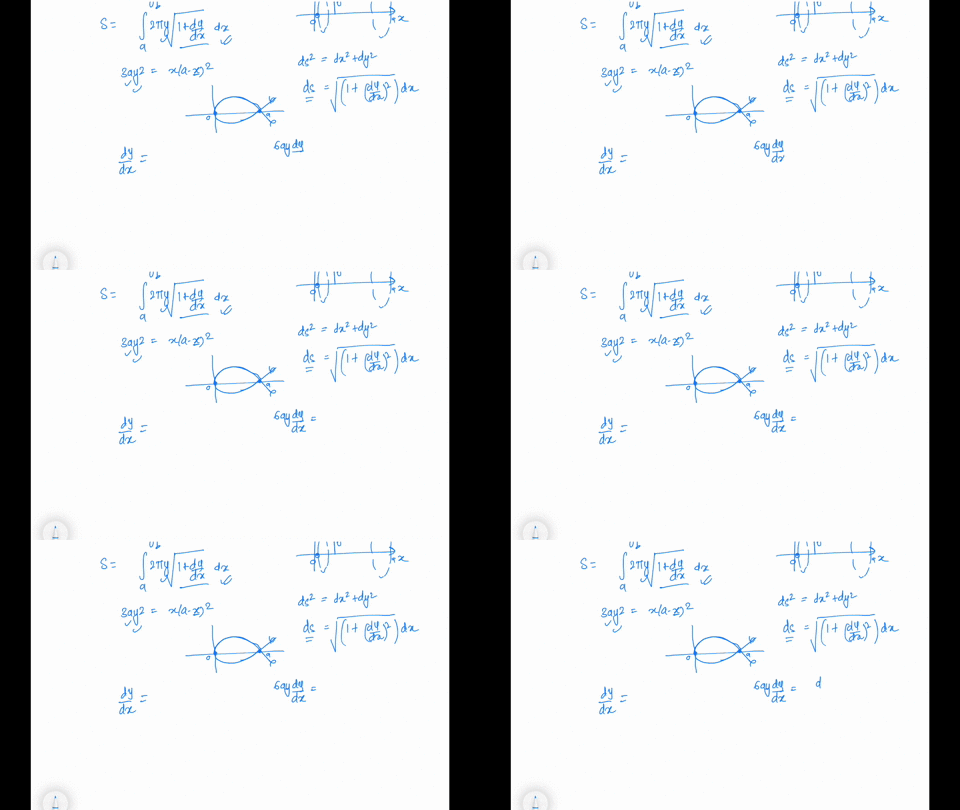
(a) If $ a > 0 $, find the area of the surface generated by rotating the loop of the curve $ 3ay^2 = x (a - x)^2 $ about the x-axis.
(b) Find the surface area if the loop is rotated about the y-axis.

Chapter 8: Further Applications of Integration
Section 2: Area of a Surface of Revolution
Pawan Yadav
05:34
Calculus: Early Transcendentals

Solve the differential equation and use a calculator to graph several members of the family of solutions. How does the solution curve change as $ C $ varies?
$ xy' = x^2 + 2y $

Chapter 9: Differential Equations
Section 5: Linear Equations
Pawan Yadav
05:37
Calculus: Early Transcendentals

In the circuit shown in Figure 4, a battery supplies a constant voltage 40 V, the inductance is 2 H, the resistance is $ 10 \Omega, $ and $ I(0) = 0. $
(a) Find $ I(t). $
(b) Find the current after 0.1 seconds.

Chapter 9: Differential Equations
Section 5: Linear Equations
Pawan Yadav
09:55
Calculus: Early Transcendentals

In the circuit shown in Figure 4, a generator supplies a voltage of $ E(t) = 40 \sin 60t $ volts, the inductance is 1 H, the resistance is $ 20 \Omega, $ and $ I(0) = 1 A. $
(a) Find $ I(t). $
(b) Use a graphing device to draw the graph of the current function.

Chapter 9: Differential Equations
Section 5: Linear Equations
Pawan Yadav
09:46
Calculus: Early Transcendentals

In the circuit of Exercise 29, $ R = 2 \Omega, C = 0.01 F, Q(0) = 0, $ and $ E(t) = 10 \sin 60t. $ Find the charge and the current at time $ t. $

Chapter 9: Differential Equations
Section 5: Linear Equations
Pawan Yadav
05:30
Calculus: Early Transcendentals

Let $ P(t) $ be the performance level of someone learning a skill as a function of the training time $ t. $ The graph of $ P $ is called a learning curve. In Exercise 9.1.15 we proposed the differential equation
$ \frac {dP}{dt} = k[M - P(t)] $
as a reasonable model for learning, where $ k $ is a positive constant. Solve it as a linear differential equation and use your solution to graph the learning curve.

Chapter 9: Differential Equations
Section 5: Linear Equations
Pawan Yadav
1 2 3 4 5 ... 78

Pawan's Quick Ask Videos

04:06
Intro Stats / AP Statistics

In a casino game chuck-a-luck, three unbiased six-sided dice are rolled.One possible bet is $1 on fives, and the payoff is equal to $1 for each five on that roll. In addition, the
dollar bet is returned if at least one five is rolled. The dollar that was bet is lost only if no fives are rolled. Let X denote the payoff for this game. Then X can equal – 1, 1, 2, or 3.

a) Determine the p.m.f. f( x ).
b) Calculate µ and ?2.

Pawan Yadav
07:19
Calculus 3

Pawan Yadav
02:59
Calculus 3

An integer from 300 through 780, inclusive is to be chosen at random, find the probability that the
number is chosen will have 1 as at least one digit.

Pawan Yadav
03:05
Calculus 1 / AB

A coach wishes to give a message to a trainee. The probabilities that he uses email, letter and
handphone are 0.4,0.1 and 0,5 respectively. He uses only one method. The probabilities of the
trainee receive the message if the coach uses email, letter or handphone are 0.6,0.8 and 1
respectively
a. Find the probability the trainee receives the message
b. Given that the trainee receives the messages, find the conditional probabilities that he
receives it via email

Pawan Yadav
03:29
Calculus 1 / AB

Solve the initial-value problem
2xy'+ y = 6x, x less than, y(4) = 20

Pawan Yadav
04:30
Precalculus

Find all angles in degrees that satisfy each equation:
1. cos 3x=1
2. sin 2x=0
3.sin a= (\sqrt(2))/(2)
3. cos a= 1/2

Pawan Yadav
1 2 3 4 5 ... 44