Hunza Gilgit

Uxbridge High School
Tutor

Biography

teaching

Education

BS physics
Uxbridge High School

Educator Statistics

Numerade tutor for 5 years
6620 Students Helped

Topics Covered

Mastering Motion: Achieving Efficiency Along a Straight Line
Condensed Matter Physics
Unlocking the Power of Magnetic Fields and Forces
Understanding Structure and Bonding: A Comprehensive Guide
Discover the Power of Solids for Your Everyday Needs
Survival of the Fittest: Life Through a Darwinian Approach
Boost Your Immune System: Tips and Tricks for a Stronger Defense
The Central Dogma: Understanding Gene Expression
Exploring Vascular Plant Structure & Development: A Comprehensive Guide
Unlocking the Secrets of Sensory and Motor Mechanisms
Circulation and Gas Exchange: Vital Processes for Optimal Health
The Incredible Power of the Nervous System: Understanding its Functions
Understanding Animal Form and Function: A Comprehensive Guide
Revolutionizing Angiosperm Reproduction with Biotechnology
Unlocking the Secrets of Plant Responses to Signals | Expert Insights
Optimize Your Animal's Health with Proper Nutrition
Osmoregulation and Excretion: Maintaining Balance and Eliminating Waste
Discover the Wonders of Animal Diversity: Exploring the Richness of Life
Discover the Evolutionary Tree with Our Phylogeny Analysis Tools
Efficient Vascular Plant Transport for Optimal Growth
Discover the Power of the Cell: Unleash Your Potential with Our Products
Unlocking the Secrets of Cell Signaling: Understanding the Intricacies
Mastering Metabolism 101: A Beginner's Guide
Cellular Respiration and Fermentation: Understanding the Basics
The Fascinating History of Life: From Origins to Present
Ecosystems and Restoration Ecology: Restoring Balance and Biodiversity
Unlocking the Secrets of Photosynthesis: A Comprehensive Guide
Hormones & The Endocrine System: Understanding the Body's Chemical Messengers
The Fascinating Chemistry of Life: Discovering the Building Blocks
Acids and bases
Carbohydrates, proteins, and lipids
Mastering Matrices: An Introduction to the Fundamentals
Exploring Animal Reproduction and Development: A Comprehensive Guide
Understanding Animal Behavior: Tips and Insights
Population Ecology: Understanding the Dynamics of Living Systems
Discovering the Wonders of the Biosphere: An Introduction
Conservation Biology and Global Change: Protecting Our Planet
Discover the Best Series to Binge-Watch | Your Ultimate Guide
Introduction to Combinatorics & Probability: Understanding the Basics
Exploring Probability Topics: From Basics to Advanced Strategies
Mastering Second Order Differential Equations: Tips and Techniques
Mastering Integrals: Tips and Tricks for Calculus Success
Unlock the Power of Vectors: Discover Their Limitless Possibilities
Mastering Multiple Integrals: Techniques and Tips
Linear Regression & Correlation: Analyzing Data Relationships
Understanding Continuous Random Variables: Key Concepts
Master the Fundamentals of Physics: Learn Physics Basics
Oscillatory Motion
Electromagnetic Induction: Understanding the Science and Applications
Discovering the Sources of Magnetic Fields: A Comprehensive Guide
Explore the Fascinating World of Wave Optics - Unleash Its Potential
Explore the Fascinating World of Periodic Motion - Learn More Today!
Exploring the Fascinating World of Mechanical Waves
Discover the Science of Sound and Hearing: Your Guide to Better Listening
Motion
Explore the Fascinating Dynamics of Rotational Motion
Understanding Chemical Bonding: The Key to Molecular Structure
Explore the Fascinating World of Molecular Geometry - Discover More!
Aqueous Equilibria: Understanding the Balance of Solutions
Unlock the Secrets of Organic Chemistry: Essential Guide
Discover the Power of Gases: Benefits and Applications
Temperature and the Kinetic Theory of Gases
Understanding Electromagnetic Waves: A Comprehensive Guide
Understanding Reflection and Refraction of Light: A Comprehensive Guide
Find Your Dream Job: Discover the Best Work Opportunities
Unlock the Power of Kinetic Energy: Boost Your Efficiency Today
Unlocking the Power of Potential Energy: Discover the Benefits
Exploring the Wonders of Atomic Physics: A Comprehensive Guide
Spectroscopy
Effective Solutions for Your Business Needs
Vectors and Vector Valued Functions
Motion in 2d or 3d
Discovering the Fundamentals: Newton's Laws of Motion Explained
Mastering Newton's Laws: Tips for Applying Them Effectively
Understanding Moment Impulse and Collisions for Better Physics
Mastering the Rotation of Rigid Bodies: Tips & Techniques
Aqueous Solutions
Discover the Power of Kinetics: Unleash Your Potential
Understanding Alternating Current: A Comprehensive Guide
Save Energy and Money with Effective Conservation Techniques
Understanding Gauss's Law: A Comprehensive Guide
Calculating Electrical Power: Resistance and EMF
Master Direct Current Circuits with Our Expert Guide
Capacitance and Dielectrics: Understanding the Basics
Energy in Thermal Processes
The Laws of Motion
Exploring the Chemistry of Nonmetals: Properties and Reactions
Transition Metals
Unlocking the Power of Electric Potential: Exploring its Benefits
Exploring the Fascinating World of Transition Metals and Coordination Chemistry
Unlocking the Secrets of Thermal Properties: Understanding Matter
Discover the Fascinating World of Nuclear Physics
Understanding Electric Charge and Field: A Comprehensive Guide
Unlocking the Power of Thermodynamics: A Comprehensive Guide
Introduction and Vectors
Unlock the Secrets of Fluid Mechanics with Our Expert Guide
Exploring the Fascinating World of Electrochemistry | Learn More Now
Mastering Integration Techniques for Optimal Results
Explore the Fascinating World of Nuclear Chemistry
Discover the Power of Gravitation: Exploring the Science Behind It

Hunza's Textbook Answer Videos

03:52
Materials Science and Engineering: An Introduction

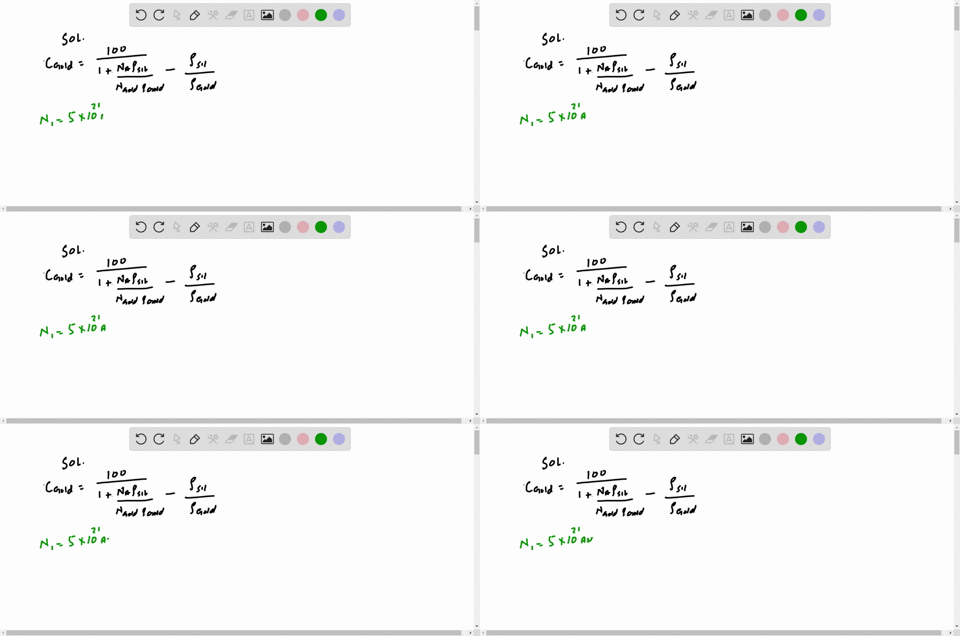
Gold forms a substitutional solid solution with silver. Compute the weight percent of gold that must be added to silver to yield an alloy that contains $5.5 \times 10^{21}$ Au atoms per cubic centimeter. The densities of pure Au and $\mathrm{Ag}$ are 19.32 and $10.49 \mathrm{g} / \mathrm{cm}^{3},$ respectively.

Chapter 4: Imperfections in Solids
Hunza Gilgit
03:18
Materials Science and Engineering: An Introduction

Germanium forms a substitutional solid solution with silicon. Compute the weight percent of germanium that must be added to silicon to yield an alloy that contains $2.43 \times 10^{21} \mathrm{Ge}$ atoms per cubic centimeter. The densities of pure Ge and $\mathrm{Si}$ are 5.32 and $2.33 \mathrm{g} / \mathrm{cm}^{3}$ respectively .

Chapter 4: Imperfections in Solids
Hunza Gilgit
01:00
Materials Science and Engineering: An Introduction

Cite the relative Burgers vector-dislocation line orientations for edge, screw, and mixed dislocations.

Chapter 4: Imperfections in Solids
Hunza Gilgit
01:21
Materials Science and Engineering: An Introduction

(a) For a given material, would you expect the surface energy to be greater than, the same as or less than the grain boundary energy? Why?
(b) The grain boundary energy of a smallangle grain boundary is less than for a highangle one. Why is this so?

Chapter 4: Imperfections in Solids
Hunza Gilgit
00:56
Materials Science and Engineering: An Introduction

(a) Briefly describe a twin and a twin boundary
(b) Cite the difference between mechanical and annealing twins

Chapter 4: Imperfections in Solids
Hunza Gilgit
1 2 3 4 5 ... 825

Hunza's Quick Ask Videos

01:40
Physics 101 Mechanics

3.5. Which of the following is true about the ball’s velocity and acceleration the highest
point B?
A. Its velocity and acceleration are both zero
B. Its velocity is upwards and a non-zero constant, and acceleration is zero
C. Its velocity is downwards and a non-zero constant, and acceleration is zero
D. Its velocity is zero, acceleration is upwards and a non-zero constant
E. Its velocity is zero, acceleration is downwards and a non-zero constant

Hunza Gilgit
04:04
Physics 101 Mechanics

A 4525 kg rocket is being shot into orbit so that it is orbiting 350,000 m above the surface of the Earth. (RE = 6.371 x 10^6 m, ME = 5.96 x 10^24 kg)

A. What is the radius of the rocket's orbit?
B. What must be the velocity of the rocket to maintain a stable orbit at that height?
C. What is the period of the rocket's orbit?

Hunza Gilgit
01:32
Physics 101 Mechanics

An athlete stands still, then crouches down 0.2 m and then
stands up quickly to the same standing still height. The athlete
completes this entire scenario in 4 seconds.
1. What is the athlete's instantaneous velocity at the time she
is standing still?

Hunza Gilgit
03:28
Physics 101 Mechanics

A particle moves along a path according to the equations
x = k -
t4/9 and y =
t2/3
where x and y are in meters and t is in seconds. Determine the
magnitude of the velocity (in m/s) of the particle as it passes the
y-axis if k = 20. Round off your final answer to three
decimal places.

Hunza Gilgit
04:37
Physics 101 Mechanics

The equation of a transverse wave traveling in a rope is given by y = 60 cos(Ï€/2)(0.005x - 8.0t - 0.57), in which x and y are expressed in centimeters and t in seconds. Write down the equation of a wave that when added to the given one, would produce standing waves on the rope.

Hunza Gilgit
03:43
Physics 101 Mechanics

A storage tank at STP contains 24.7 kg of
nitrogen (N2). What is the pressure if an additional 26.2
kg of nitrogen is added without changing the temperature?

Hunza Gilgit
1 2 3 4 5 ... 271