Sheh Lit Chang

University of Washington
Teaching Assistant

Biography

Taught introductory physics, quantum mechanics, and electricity and magnetism

Education

Phd Physics
University of Washington
BS Physics and Materials Science and Engineering
National University of Singapore

Educator Statistics

Numerade tutor for 7 years
3152 Students Helped

Topics Covered

Unlocking the Power of Magnetic Fields and Forces
Mastering Motion: Achieving Efficiency Along a Straight Line
Motion in 2d or 3d
Discovering the Fundamentals: Newton's Laws of Motion Explained
Exploring the Fascinating World of Quantum Physics
Exploring the Wonders of Atomic Physics: A Comprehensive Guide
Discover the Fascinating World of Nuclear Physics
Unlock the Secrets of Fluid Mechanics with Our Expert Guide
Explore the Fascinating World of Wave Optics - Unleash Its Potential
Explore the Fascinating World of Periodic Motion - Learn More Today!
Exploring the Fascinating World of Mechanical Waves
Discover the Science of Sound and Hearing: Your Guide to Better Listening
Understanding Moment Impulse and Collisions for Better Physics
Mastering the Rotation of Rigid Bodies: Tips & Techniques
Explore the Fascinating Dynamics of Rotational Motion
Understanding Equilibrium and Elasticity: A Comprehensive Guide
Calculating Electrical Power: Resistance and EMF
Master Direct Current Circuits with Our Expert Guide
Electromagnetic Induction: Understanding the Science and Applications
Understanding Temperature and Heat: A Comprehensive Guide
Unlocking the Secrets of Thermal Properties: Understanding Matter
Understanding the First Law of Thermodynamics: Key Concepts
Understanding the Second Law of Thermodynamics: Key Principles
Fluid Mechanics
Unlocking the Power of Electric Potential: Exploring its Benefits
Master the Fundamentals of Physics: Learn Physics Basics
Unlock the Power of Kinetic Energy: Boost Your Efficiency Today
Unlocking the Power of Potential Energy: Discover the Benefits
Save Energy and Money with Effective Conservation Techniques
Mastering Newton's Laws: Tips for Applying Them Effectively
Understanding Reflection and Refraction of Light: A Comprehensive Guide
Understanding Alternating Current: A Comprehensive Guide
Understanding Inductance: A Comprehensive Guide
Capacitance and Dielectrics: Understanding the Basics
Find Your Dream Job: Discover the Best Work Opportunities
Kinetic Theory Of Gases
Understanding Electric Charge and Field: A Comprehensive Guide
Discovering the Sources of Magnetic Fields: A Comprehensive Guide
Understanding Gauss's Law: A Comprehensive Guide
Understanding Electromagnetic Waves: A Comprehensive Guide
Relativity
Motion
Discover the Power of Gravitation: Exploring the Science Behind It
Mastering Partial Derivatives: Essential Techniques and Tips
Applications of the Derivative
Introduction and Vectors
Differential Equations Made Simple: Expert Tips & Resources
Discover the Fascinating World of Particle Physics Today
Applications of Newton’s Laws
Oscillatory Motion
Stand Out with Differentiation Strategies | Boost Your Business
Gravity, Planetary Orbits
Introduction to Vector Calculus
Electric Forces and Electric Fields
Understanding Chemical Equilibrium: A Comprehensive Guide
Understanding Structure and Bonding: A Comprehensive Guide
Electric Potential and Capacitance
Current and Direct Current Circuits
Rotational Motion
Temperature and the Kinetic Theory of Gases

Sheh Lit's Textbook Answer Videos

01:55
University Physics with Modern Physics

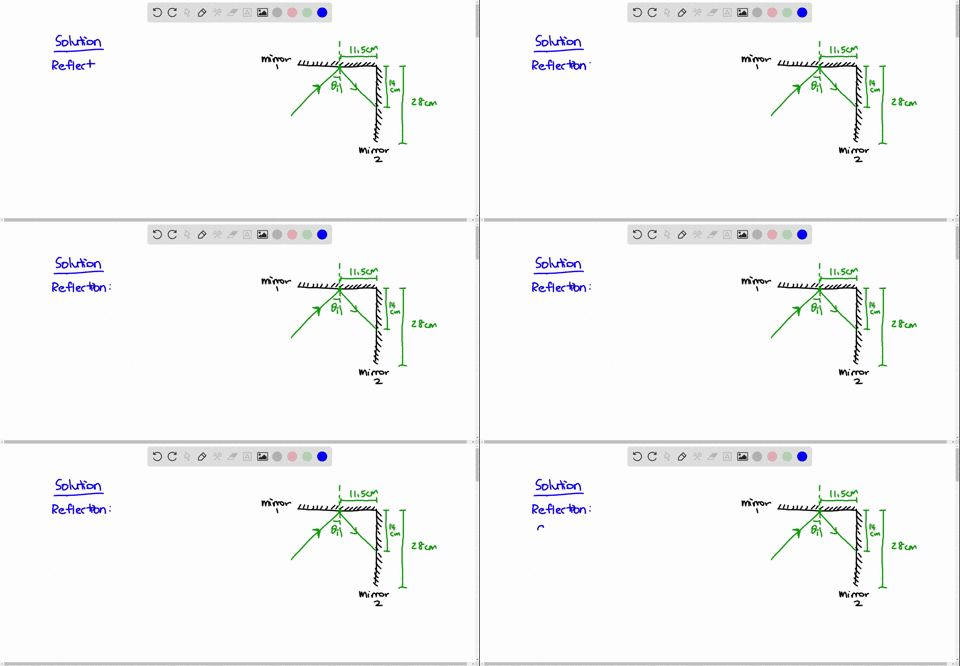
Two plane mirrors intersect at right angles. A laser beam strikes the first of them
at a point 11.5 cm from their point of intersection, as shown in $\textbf{Fig. E33.1}$. For what angle of incidence at the first mirror will this ray strike the midpoint of the second mirror (which is 28.0 cm long) after reflecting from the first mirror?

Chapter 33: The Nature and Propagation of Light
Section 2: Reflection and Refraction
Sheh Lit Chang
04:32
University Physics with Modern Physics

A narrow beam of white light strikes one face of a slab of silicate flint glass. The light is traveling parallel to the two adjoining faces, as shown in $\textbf{Fig. E33.23}$. For
the transmitted light inside the glass, through what angle $\Delta \theta$ is the portion of the visible spectrum between 400 nm and 700 nm dispersed? (Consult the graph in Fig. 33.17.)

Chapter 33: The Nature and Propagation of Light
Section 4: Dispersion
Sheh Lit Chang
03:57
University Physics with Modern Physics

A ray of light is incident in air on a block of a transparent solid whose index of refraction is $n$. If $n$ = 1.38, what is the $largest$ angle of incidence $\theta_a$ for which total internal reflection will occur at the vertical face (point A shown in $\textbf{Fig. P33.39}$)?

Chapter 33: The Nature and Propagation of Light
Sheh Lit Chang
06:21
University Physics with Modern Physics

Optical fibers are constructed with a cylindrical core surrounded by a sheath of cladding material. Common materials used are pure silica $n_2 = 1.4502$ for the cladding and silica doped with germanium $n_1 = 1.4652$ for the core. (a) What is the critical angle $\theta_{crit}$ for light traveling in the core and reflecting at the interface with the cladding material? (b) The numerical aperture (NA) is defined as the angle of incidence $theta_i$ at the flat end of the cable for which light is incident on the core-cladding interface at angle $\theta_{crit}$ ($\textbf{Fig. P33.46}$). Show that sin $\theta_i$ =$ \sqrt {n^2_1 - n^2_2}$ . (c) What is the value of $\theta_i$ for $n_1$ = 1.465 and $n_2$ = 1.450?

Chapter 33: The Nature and Propagation of Light
Sheh Lit Chang
11:01
University Physics with Modern Physics

A convex mirror and a concave mirror are placed on the same optic axis, separated by a distance $L$ = 0.600 m. The radius of curvature of each mirror has a magnitude of 0.360 m. A light source is located a distance $x$ from the concave mirror, as shown in $\textbf{Fig. P34.87}$. (a) What distance $x$ will result in the rays from the source returning to the source after reflecting first from the convex mirror and then from the concave mirror? (b) Repeat part (a), but now let the rays reflect first from the concave mirror and then from the convex one.

Chapter 34: Geometric Optics
Sheh Lit Chang
05:22
University Physics with Modern Physics

As shown in $\textbf{Fig. P34.89}$, the candle is at the center of curvature of the concave mirror, whose focal length is 10.0 cm. The converging lens has a focal length of 32.0 cm and is 85.0 cm to the right of the candle. The candle is viewed looking through the lens from the right. The lens forms two images of the candle. The first is formed by light passing directly through the lens. The second image is formed from the light that goes from the candle to the mirror, is reflected, and then passes through the lens. (a) For each of these two images, draw a principal-ray diagram that locates the image. (b) For each image, answer the following questions: (i) Where is the image? (ii) Is the image real or virtual? (iii) Is the image erect or inverted with respect to the original object?

Chapter 34: Geometric Optics
Sheh Lit Chang
1 2 3 4 5 ... 506

Sheh Lit's Quick Ask Videos

06:40
Physics 102 Electricity and Magnetism

Sheh Lit Chang
03:48
Physics 101 Mechanics

4. A power station delivers 25 MW of electrical power. How many tonnes of fuel oil would be needed by this station to deliver the 25 MW of power for 1 month of 30 days, assuming a conversion efficiency of 35%. (1 tonne of oil equivalent in energy = 4.2 × 10¹⁰ J; 1 tonne = 1000 kg.

Sheh Lit Chang
02:50
Physics 101 Mechanics

a car of mass 1063kg climbs a 5.0° slope at a constant speed of 72.0km/h. assuming that air resistance may be neglected at what rate must the engine deliver mechanical energy to the car?

14kW
231kW
18kW
20kW

Sheh Lit Chang
04:02
Physics 101 Mechanics

An object displaced with an amplitude of 140 mm at a period of 1.3334 x 10⁻³min and moves according to the simple harmonic motion. If at time t = 0 the object is 0.07 m from the equilibrium, i.Write the expression for the object’s displacement in cm and ?.(7 marks)ii.Find the displacement in m at t = T/5 and round your answerto the nearest thousandths.

Sheh Lit Chang
06:50
Physics 101 Mechanics

In the situation shown, the bottom block is being pulled to the left but is not sliding. The top block is attached by a taut string to the wall and is not allowed to move left. The blocks and floor have identical surface roughness. a) Draw separate force diagrams for each block. Indicate action-reaction pairs with ×’s. b) Suppose the coefficient of static friction is ????s = 0.2, the top block has mass 4 kg, and the bottom block has mass 6 kg. At least how hard must the person pull to get the bottom block to slide?

Sheh Lit Chang
03:39
Physics 101 Mechanics

1. A skier, starting from rest, skis down a slope from a height of 300 m to the horizontal ground level. (a) Show that the speed with which the skier reaches the ground level does not depend on either the mass of the skier or the angle of incline of the slope. State any assumptions made. (b) Calculate the speed with which the skier reaches the ground level.

Sheh Lit Chang
1 2 3 4 5 ... 8